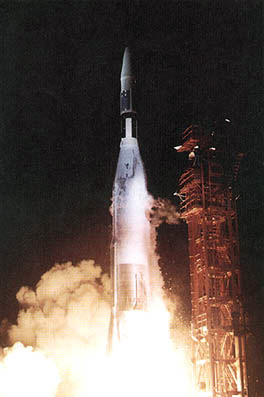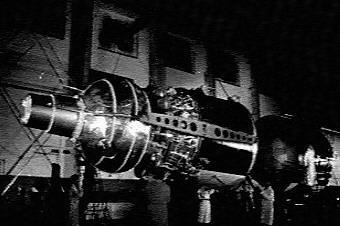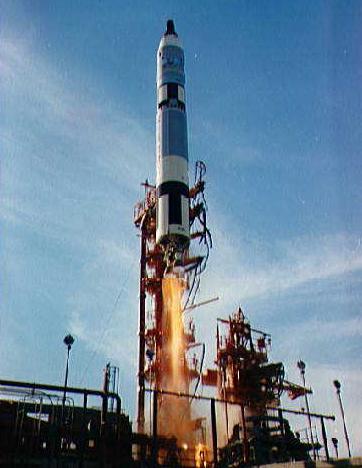

50 years ago today, the first Titan IIIC rocket was launched from Pad 40, Cape Kennedy.
It was the first use of large-scale solid-rocket boosters to augment a liquid-fueled rocket. It was also the third test of the Transtage upper stage.
Its only payload was a 21,000-lb lead ballast. Placed in a roughly 110-mile orbit, it re-entered 11 days later.
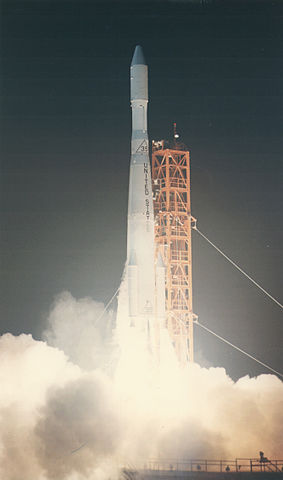
It would be the beginning of 40 years as a space exploration and military payload workhorse. Five different versions would be used: The Titan IIIC, the Titan IIID (which lacked the Transtage), the Titan IIIE (which replaced Transtage with the Centaur liquid hydrogen-fueled upper stage), Titan 34D (upgraded version of Titan IIID), and the Titan IV.
They would be used for reconnaissance satellites, with the occasional launch of NASA deep space probes. A limited run in the early 1990s, called the Commercial Titan III, would be used for some heavier commercial payloads with mixed success. Of four launches, two suffered failures.
One, the comsat Intelsat 603, would fail to separate from its launch vehicle, necessitating intervention from the Space Shuttle (STS-49) to send it to its intended orbit.
The other one, Mars Observer, launched successfully but failed right before arriving at Mars.